
Colour at London's Glitch
Colour tattooing opens up an enormous range of possibilities. From subtle accents and soft botanical palettes to saturated traditional work, vivid surrealism and detailed colour realism, colour can completely change the mood, depth and character of a tattoo.
At London's Glitch, our colour tattoo artists approach colour in different ways. Some build entire compositions around it, while others use it selectively alongside blackwork, fine line, realism or other techniques.
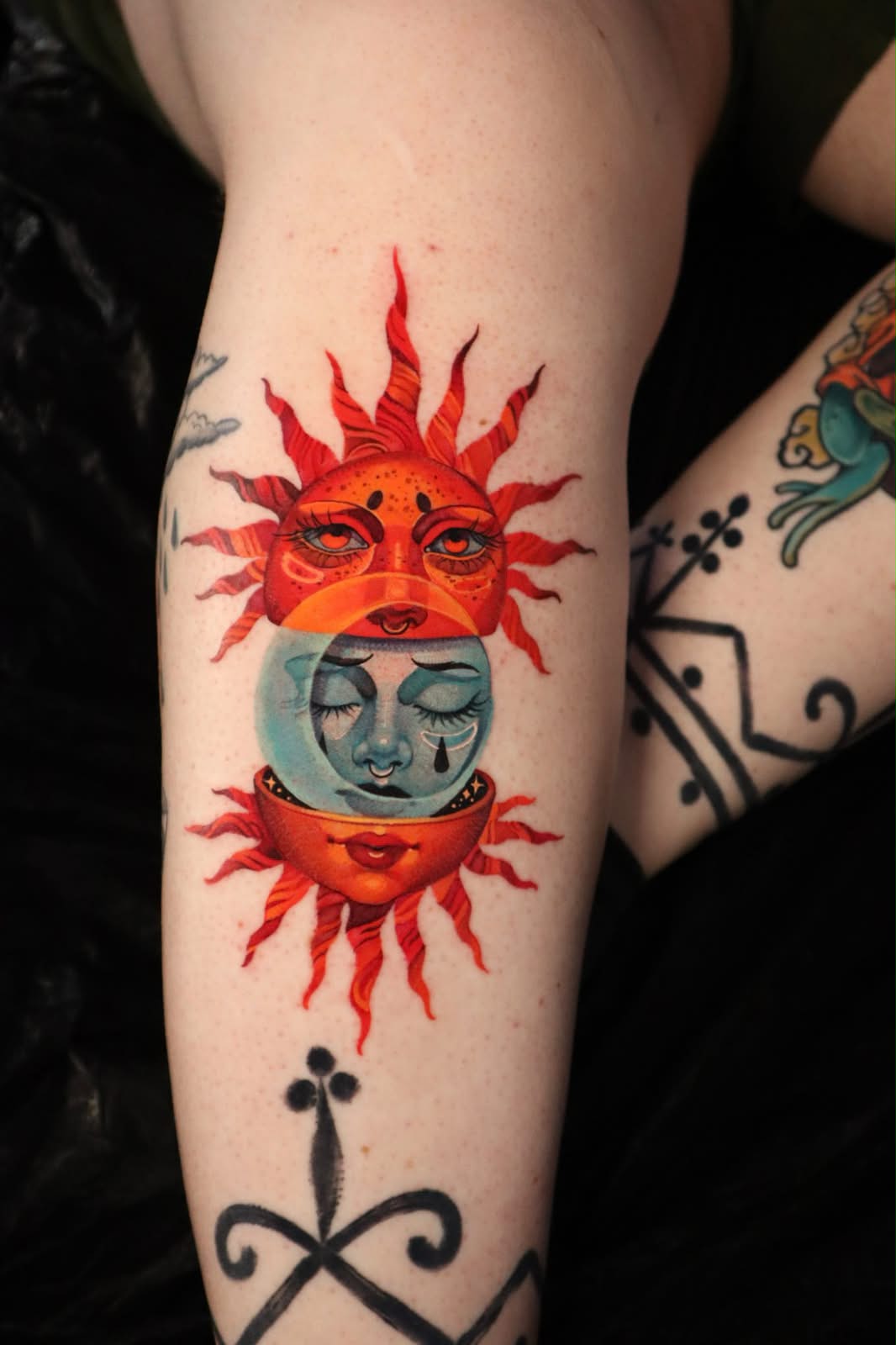
Colour tattooing is less a single style than a creative tool. Colour can be used to create contrast, atmosphere, depth, realism, symbolism or simply a completely different visual energy from black and grey work.
The approach can range from highly saturated areas of pigment to delicate washes, subtle accents and carefully controlled palettes. Some tattoos use dozens of tones to create dimensional imagery, while others may rely on only one or two colours against black ink or negative space.
Colour can appear across almost every tattoo discipline. Traditional and Neo-Traditional tattooing often use strong, saturated palettes and clear contrast. Realism can reproduce the complex tones found in photographs and nature. Botanical tattoos can range from soft natural palettes to vivid reinterpretations, while surreal and Avant-Garde work can use colour in much more experimental ways.
At London's Glitch, our artists each have their own relationship with colour. Some specialise in bold saturation, others work with softer palettes, selective colour or combinations of colour and blackwork. The palette should serve the design rather than being added simply for decoration.
Skin tone is an important part of colour tattooing. Pigments interact with the natural tone of the skin, so colour choices, contrast and saturation should be considered individually. An experienced artist will adapt the palette and design so the tattoo remains visually strong on the person wearing it.
Placement and scale also influence how colour is used. Larger areas can support more complex tonal transitions and combinations, while smaller tattoos — including fine line and microrealism pieces — may benefit from a simpler palette and stronger separation between colours.
Good saturation and technical application are important for both the immediate appearance and long-term readability of a colour tattoo. Healing, sun exposure and aftercare also influence how colour develops over time, which is why protecting healed tattoos from prolonged UV exposure is especially important.
Colour tattoos can be small and subtle or become large-scale sleeves, back pieces and multi-session projects. The appropriate approach depends on the concept, placement, level of detail and the artist's visual language.
At London's Glitch, colour is never treated as one fixed aesthetic. It can be the main character of a tattoo, a small accent within an otherwise black and grey design, one element within a project combining several disciplines, or part of a cover-up that reworks existing ink.
If you know you want colour but are not sure what style or palette would suit your idea, you do not need to decide that beforehand. Tell us what you have in mind and we can help identify the London's Glitch artist whose approach best suits the project.
Colour Artists at London's Glitch



Want colour but not sure which direction to take?
Tell us about your idea, references and the kind of feeling you want the tattoo to have. We'll help you find the artist, palette and approach that best suit the project.